

It’s the first Sunday of the month, which means I’m unlocking a paid post for everyone.
Want to have access to coaching tools, mental frameworks, and live webinars? Upgrade to paid to get the full experience:
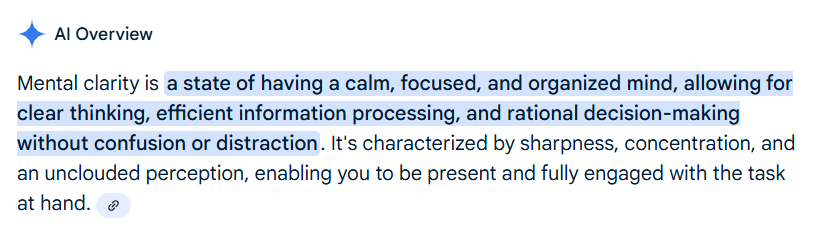
Some trading days are smooth. You wake up, sit down, open the charts, and things just click. The market looks almost welcoming. You’re not forcing decisions, you’re not overthinking, you’re not second-guessing yourself… The session ends, and instead of feeling drained, you feel light: “This was easy”.
Other days… you know exactly how this goes. You wake up heavy, maybe your sleep wasn’t great, maybe you’ve got ten different things buzzing in your head. You open the charts and experience mental fog. What didn’t use to be a big deal triggers you more easily—your tolerance to discomfort has shrunk. These are the days you’re most prone to screw up.
It’s night and day. And that difference is called mental clarity.
Here’s the thing:
It’s not the strategy that makes the profits — it’s you, the trader.
When your mind is foggy, even the best system shifts. But in mental clarity, that’s when your true edge appears — the only state where peak performance can emerge.
So, I wanna share with you:
What this difference implies in terms of execution.
When it actually makes sense to bend your trading rules.
A downloadable template to map your two performance states and step closer to your IPM.
(Saturday’s webinar recording at the bottom).
Let’s dive in!
The Discomfort Threshold
Here’s what I’ve learned both from my own trading and from coaching traders: mental clarity isn’t just “feeling good.” It’s not waking up in a good mood and calling that clarity. It’s about the emotional buffer you bring into your trading.
When clarity is high, that buffer is wide. You can take one or two losses, and it barely shakes you. You just see price action with a type of clarity that’s hard to explain, but that we all have experienced before. You accept discomfort more naturally, and things just seem to flow differently…
But when clarity is low? That buffer is also smaller. One loss is enough to put you on edge. You get triggered with less, you start negotiating with yourself: “I need to make the L back, I can’t end red, I’ll just bend the rule this once.”
Same market, same system, but different trader in fog vs. clarity.
This is why two traders with identical strategies can have completely different results on the same day. And why one trader — you — can have completely different results depending not on the market, but on your state of mind.
Rules, Intuition, and Knowing When to Push
Here’s the paradox I see all the time: rules are both the thing that saves us and the thing that holds us back.
On foggy days, rules will be your best friend — they keep you safe from yourself, protect you from revenge trades, from overtrading, from turning one bad morning into a ruined month. When your mind is cloudy, rules are guardrails.
But on days of mental clarity, rules are not guardrails anymore — they’re trampolines. They give you structure to bounce off, but you also have the freedom to bend them (not all as I explain below). On those days, when you’re fully synced with the market, that’s when flexibility becomes part of performance.
But there’s a thin line here…
Breaking rules in clarity is not the same as breaking rules in fog.
In clarity, you’re more centered and in touch with yourself, so breaking a rule comes from a place of intuition.
In fog, breaking rules most often comes from lack of awareness, high emotionality, or sloppy mistakes.
And to be clear: flexibility isn’t throwing your rulebook out the window. That’s not flexibility — that’s recklessness, usually fueled by overconfidence.
So, what does healthy flexibility actually look like?
Here are a few examples:
1. Letting go of rigid daily limits.
Maybe you have a “one trade per day” rule, or a “two losses max” rule, or the classic “one winner and done.” Those rules are brilliant on days your Self 1 is stronger — they stop the bleeding when you’re not in rhythm. But on days of clarity, they can limit you. If the market is trending beautifully, setups are clean, and you’re in sync, why limit yourself? That might be the day to take that third trade, or to press further into opportunity.
2. Adding to conviction.
Sometimes flexibility means pressing an advantage. Let’s say you’re already in a strong trend trade, and every signal reinforces the move. On a clarity day, you might add to your position — pyramiding with proper risk management, which I consider to be not adding more risk, going risk-free first before adding.
3. Holding longer than the plan.
Your playbook might say to take profits at 1R or 2R. But on days when clarity is high, you may sense the market breathing differently. The move has momentum, and you feel calm enough to extend the target and let the trade run. Or to leave a runner. Of course, there’s a downside you must be willing to accept: the trade could reverse all the way back to your stop. But here’s the difference: on clarity days, your acceptance threshold is wider — you can live with the downside. Without that acceptance, it’s not intuition, it’s overconfidence — blindness to risk.
4. Increasing size consciously.
If you want to work on increasing your risk tolerance and your account size allows, clarity days are a great opportunity to upgrade your risk per trade (on high-quality setups and in small increments).
Flow vs. Resistance
I can’t talk about clarity without coming back to Timothy Gallwey’s Inner Game series, as I also mentioned in previous posts. He talks about two selves: Self-1, the inner critic, and Self-2, the natural performer.
When I’m in fog, I’m all Self-1. Constant interference. “Don’t miss trades. Don’t screw this up. Why are you hesitating? You’re better than this.” Even on days when the market does nothing, that voice is enough to leave me exhausted.
But when I’m in clarity, Self-2 takes over. Things flow, actions feel effortless, the market looks wayyy simpler. That doesn’t mean I believe it’ll be a winning day; it means there’s no resistance to the market reality. Win or lose, I walk away lighter.
This is what I want traders to pay attention to. Because if you only ever know yourself in resistance mode — if you’ve never really noticed what it feels like to trade from Self-2, from clarity — then you’ll never know what peak performance actually feels like.
And if you don’t know it, you can’t recreate it.
That’s where the Ideal Performance Mindset (IPM) comes in. IPM is about recognizing these two realities — resistance vs. flow — and getting to know them so well that you can identify which state you’re in within minutes. Once you know it, you can align your trading with it.
Making It Real
Here’s an exercise for you in a Notion page I created. I like to give you these because it puts theory into action.
On one side, write down what you look, feel, and sound like in the flow state (clarity, Self-2). On the other side, do the same for the resistance state (fog, Self-1).
How does the market appear to you?
How do you handle losses?
What’s the inner dialogue?
What does your body feel like?
What kind of urges show up (to chase, hesitate, overtrade)?
How do you end the session?
This is your personal performance map. When you fill this out honestly, you’ll build a mirror of yourself at your best and at your most resistant. And it looks different for all traders. Grab the template here:
My Challenge to You:
Perhaps the biggest thing to take away is that we’re humans and we’re not linear. It’s not that you wake up with the same mood, clarity, and emotions every day. And you should respect that.
Now, this doesn’t mean you can’t access your Ideal Performance Mindset (IPM) and create clarity. From the moment you know your Self 2 very well, it just gets easier to tap into it more often.
When we say “the trader is the biggest part of the edge,” this is exactly what we mean.
So here’s my challenge to you this week: pay attention. I want you to go into each session not just to trade, but to observe your state — are you in resistance or in clarity? Most of the time, you’ll recognize it within the first minutes of market open, and it tends to stay stable for that session. It swings more from day to day than intraday. But you can also transition from clarity to resistance in a single session, so pay attention to that shift.
Notice when you’re in flow. Write it down in the template above. Because once you’ve lived through both and mapped both, you’ll know the difference. And when you know the difference, you’ll know exactly when to play defense, when to press offense — and when clarity meets opportunity, you’ll know it’s your moment to shine.
In Closing
Mental clarity is an edge. Without it, you can have the best system in the world and still sabotage yourself.
Trading in fog is like sprinting with ankle weights. Trading in clarity is still work — but at least you’re not fighting yourself.
And when you’re not fighting yourself, that’s where your higher performance has space to emerge.
Grab the journal and tap into it this week!
Love,
Sara
Sharing the recording of Saturday’s webinar — such an engaging session, full of ideas from everyone! <3
Webinar Recording: The Power of Extreme Self-Awareness

Thank you to everyone who joined the webinar yesterday — it was incredible, one of my favorites so far! The interaction, questions, and ideas shared by the audience made it a really valuable session.
Related Reads:


