
The Performance Gap: Why You’re Not Trading as Well as You Could
A framework to identify, measure, and reduce the gap between your average and ideal performance.

One of the biggest obstacles I see in trading performance is something that might surprise you:
Knowledge.
We assume that more knowledge should lead to better results.
But in my experience working with professional traders, that’s not what moves the needle.
In fact, the constant search for more knowledge can create the illusion of progress — you feel productive, you feel like you’re improving. But in most cases, it postpones dealing with the deeper root of the issue affecting your execution.
I see this pattern enough to recognize it instantly:
A trader struggles with pre-emptive entries driven by FOMO, so they try to solve it by adding more confluence to their strategy.
They believe that if they just understand the market better, their trades will become more precise and their win rate will improve.
Except… the opposite usually happens.
More information creates more noise, more complexity, more analysis paralysis. And the illusion of control becomes stronger than the acceptance of uncertainty.
The real issue in cases like this is not a lack of knowledge.
It’s performance consistency.
Most traders already know what their ideal execution looks like. But their trading falls short of it.
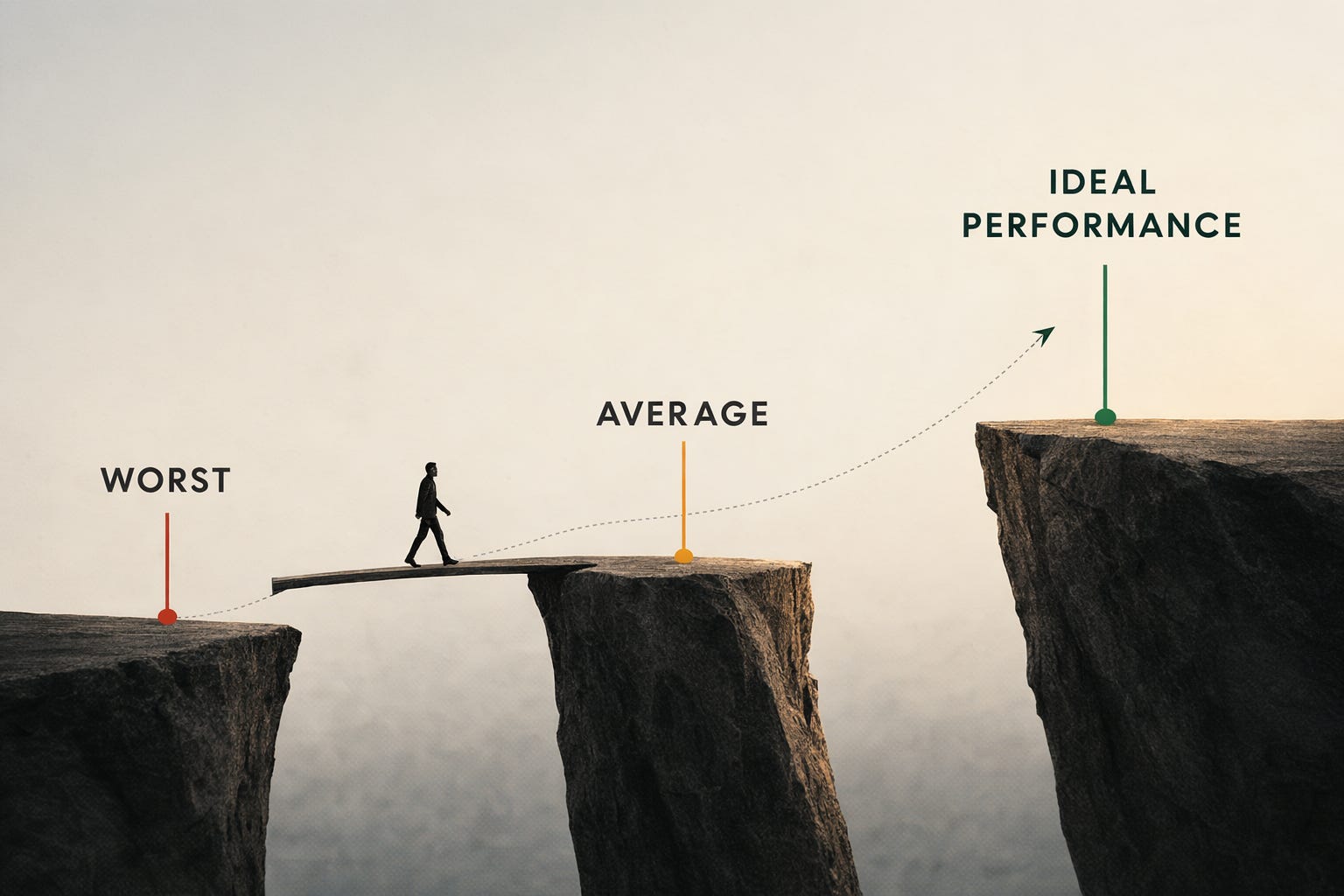
The distance between those two states — average execution and ideal execution — is what I call the performance gap.
And as traders, closing that gap is an ongoing part of the job.
In this post, I’ll show you how to identify, measure, and start closing your performance gap, using a real case study from a trader and the practical adjustments we implemented.